Friday, February 14, 2020

Announcing Our Next Four Selections

Are you ready? Here are the next four selections of our book club, with which we will keep each other's company during the year 2020:

Deb (Kahakai Kitchen) opens the series with Hippie Food by Jonathan Kauffman (published January 2018) for the April/May edition


For our April/May 2020 pick, I had to go with the book that was just edged out by The Food Explorer as my choice or the last round: Hippie Food: How Back-to-the-Landers, Longhairs, and Revolutionaries Changed the Way We Eat by Jonathan Kauffman. Food history fascinates me and I want to learn more about how tofu, brown rice, and veggie burgers made their way into the mainstream. It's also a good excuse to hit up my Moosewood Collective cookbook collection for some hippie fare.  

From the publisher:
An enlightening narrative history—an entertaining fusion of Tom Wolfe and Michael Pollan—that traces the colorful origins of once unconventional foods and the diverse fringe movements, charismatic gurus, and counterculture elements that brought them to the mainstream and created a distinctly American cuisine. 
Food writer Jonathan Kauffman journeys back more than half a century—to the 1960s and 1970s—to tell the story of how a coterie of unusual men and women embraced an alternative lifestyle that would ultimately change how modern Americans eat. Impeccably researched, Hippie Food chronicles how the longhairs, revolutionaries, and back-to-the-landers rejected the square establishment of President Richard Nixon’s America and turned to a more idealistic and wholesome communal way of life and food. 
From the mystical rock-and-roll cult known as the Source Family and its legendary vegetarian restaurant in Hollywood to the Diggers’ brown bread in the Summer of Love to the rise of the co-op and the origins of the organic food craze, Kauffman reveals how today’s quotidian whole-foods staples—including sprouts, tofu, yogurt, brown rice, and whole-grain bread—were introduced and eventually became part of our diets. From coast to coast, through Oregon, Texas, Tennessee, Minnesota, Michigan, Massachusetts, and Vermont, Kauffman tracks hippie food’s journey from niche oddity to a cuisine that hit every corner of this country. 
A slick mix of gonzo playfulness, evocative detail, skillful pacing, and elegant writing, Hippie Food is a lively, engaging, and informative read that deepens our understanding of our culture and our lives today.  
And how can you resist that cover?!? 

Aloha, 
Deb

Deadline for contributing your post is Sunday, May 31, 2020

For the June/July edition, Claudia (Honey from Rock) chose Kitchen Chinese by Ann Mah (published February 2010)


I read Kitchen Chinese last year, loved it, and immediately thought it would be a great pick for our Cook the Books Club. Though fiction, it resonates with the author’s real life experience. Not quite memoir, though the novel is loosely based upon her own experiences in China, when her husband was posted there. Mah says, “My husband’s diplomatic career brings frequent international moves, as well as lots of fresh material (and occasional angst) to write about, and we always have another relocation on the horizon.” 

Ann Mah's funny and poignant first novel about a young Chinese-American woman who travels to Beijing and in the process discovers food, family, and herself, is a delight--complete with mouth-watering descriptions of Asian culinary delicacies, from Peking duck and Mongolian hot pot to the colorful, lesser known Ants in a Tree that will delight foodies everywhere. 

Her tale of clashing cultures, rival siblings, and fine dining is also the story of one woman's search for identity and purpose in an exotic and faraway land. After her magazine career comes to a halt, Isabelle Lee, the author’s protagonist, leaves New York, wanting change, and hoping also to reconnect with her family roots in China. Her older sister is an attorney living there, so she has a place to stay. However, her familiarity with the language and culture is limited to 'kitchen Chinese'. 

Isabelle lands a job at a magazine for the expatriate community in Beijing and finds a circle of friends. However, her relationship with her big-shot attorney sister, Claire, who's lived in China for a while, gets off to a rocky start, with the two not knowing quite what to make of each other. Isabelle's Beijing immersion provides a refreshing and fun narrative, with insights into modern China and the expatriate experience, making for an enjoyably intriguing read.

Aloha,
Claudia

Deadline for contributing your post is Friday, July 31, 2020

For the August/September edition, Debra (Eliot's Eats) has chosen Recipe for a Perfect Wife by Karma Brown (December 2019)
  

I am always on the lookout for a new Cook the Books suggestion. I was rambling through a book store recently and saw a table devoted solely to Recipe for a Perfect Wife by Karma Brown. 

The blurb on the inside cover had me. This tale of two women in two different times (yet in the same house) had me. I figured that if the book had "recipe" in the title (and with at least one reference to meatloaf in the first few chapters), I decided I would choose Recipe for a Perfect Wife for my turn at hosting. 

From the publisher: 
In this captivating dual narrative novel, a modern-day woman finds inspiration in hidden notes left by her home’s previous owner, a quintessential 1950s housewife. As she discovers remarkable parallels between this woman’s life and her own, it causes her to question the foundation of her own relationship with her husband–and what it means to be a wife fighting for her place in a patriarchal society.
Debra

Deadline for contributing your post is Wednesday, September 30, 2020

To round up the list of selections, for the October/November edition Simona (briciole) picked the novel The Secret, Book and Scone Society by Ellery Adams (October 2017)


This book caught my attention first because of the words "book" and "scone" in the title, then because it revolves around a bookstore, whose owner, Nora, having once been healed by books, has chosen to do the same to other people. And finally, because it is a mystery.

Besides Nora, the society of the title includes three other women, quite different from each other, each with a secret to share, a story to tell. One of them is a baker, one with a special gift (which you will find out about when you read the novel). There are no recipes in the book, but food plays an important role and I hope the story will inspire you. 

Simona

Deadline for contributing your post: Monday, November 30, 2020.

Remember that membership in our book club is open to anyone and we hope you will join us by reading these selections and creating inspired recipes. For more information about participating, click here.  

As always, specific announcement posts can be found at Cook the Books at the beginning of each two-month period and the current selection is always shown on the right side of the homepage.

To recap:

April/May: Hippie Food by Jonathan Kauffman (hosted by Deb at Kahakai Kitchen)


June/July: Kitchen Chinese by Ann Mah (hosted by Claudia at Honey from Rock)


August/September: Recipe for a Perfect Wife by Karma Brown (hosted by Debra at Eliot's Eats)


October/November:The Secret, Book & Scone Society by Ellery Adams (hosted by Simona at briciole)


Happy reading and cooking!

Saturday, February 1, 2020

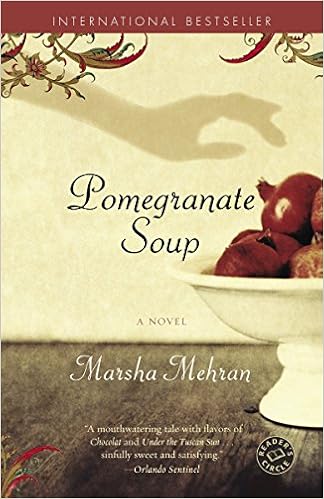
February/March selection: Pomegranate Soup


I saw the novel Pomegranate Soup by Marsha Mehran (2005) at the annual Berkeley Library sale last year (a great chance to stock up on books). I remembered reading good reviews about it, so I added it to my purchases.

Pomegranate Soup is a story of people who have fled from their country of origin and recreated their lives in a different one. In the case of the three Aminpour sisters, the first country is Iran, the second Ireland. From the kitchen of an old pastry shop in the village of Ballinacroagh, County Mayo, the sisters share foods of their native country, like red lentil soup, abgusht stew, rosewater baklava. Not everybody like the "wafts of cardamom, cinnamon, and saffron float through the streets," though, and therefore, as you can imagine, adventures ensue.

From the publisher's website:
Infused with the textures and scents, trials and triumphs of two distinct cultures, Pomegranate Soup is an infectious novel of magical realism. This richly detailed story, highlighted with delicious recipes, is a delectable journey into the heart of Persian cooking and Irish living.
Ms. Mehran died in Ireland in 2014, aged 37, while she was working on the third book of the Aminpour sisters' series (the second, Rosewater and Soda Bread, was published in 2008). I am even gladder to feature Pomegranate Soup as our selection: reading what she wrote and shared with the world is, in my view, the best way to honor her memory.

Simona

Deadline for contributing your post: Tuesday, March 31, 2020.
Leave a comment below with a link to your post or email me at simosite AT mac DOT com.

Remember that anyone can participate in Cook the Books: simply pick up a copy of the selection from your local bookstore or library, take inspiration from said reading, cook and post the inspired dish. We look forward to having you read and cook along with in this selection period and beyond. New participants are always welcomed with open arms! (Leave a comment here or check out our Guidelines page if you have any questions.) 

This selection brings to a close the current set of four: be on the lookout for a post where we announce the next four selections.

Friday, January 31, 2020

Language of Flowers Round Up

I read this book three years ago and was struck just how much food was mentioned in the novel. At the time I thought it would be a great recommendation for Cook the Books.


Here's my Good Reads review from 2017:


I did love this book...even with all the coincidence...even with all the improbability...even with the sometimes dark themes. The Language of Flowers is a cross between White Oleander (because of the foster care system depiction) and Garden Spells (because of the power of the flowers). 
Victoria has aged-out of the foster care system and finds herself homeless and without any job prospects. But, she has the "language of flowers" to fall back on. Her gift lands her a job with a local florist and allows her to reconnect with her past while visiting the flower market. Victoria's "gift" with the language of flowers is more of her education and knowledge versus a mystical talent. I don't know if I would have enjoyed the book as much if Diffenbaugh had gone over to the mystical side.
I didn't like Part 4 as much as the first three sections of the book. To discuss it further would be a spoiler. Just suffice it to say that Victoria has to work through some "mommy issues." 

While rereading for this event, I was struck with just how much of the plot I had forgotten. In my head, I remembered a happy ending early on. I had totally forgotten the pain and emotion of Part 4. (Maybe that's why I state I did not enjoy it.) On my second reading of the novel, I could not get past the outrageous pain, danger, and psychological issues that Victoria deals with. How did she survive and even thrive (though some would argue that last point)?

How many Victorias are out there that do not thrive or survive? I can't even fathom it.

Even though this novel had some dark themes, I think everyone enjoyed the read.

Cam from Culinary Adventures with Camilla was first up on December 2 with her post.   She knows the author!   (Or, sort of as she writes.)    Another connection with the book is that Cam used to be a florist!  Who knew?  

I'm so glad that somebody did a riff on the donut theme running through the book.  Check out this hilarious box that Camilla purchased from a school-run culinary program.
Cam loved the book and I love that she points out that Victoria  "ends up with a whole tribe of people who care for her."


Wendy from A Day in the Life on the Farm was next up with a chicken recipe.   (There are at least two significant roasted chicken dishes mentioned on the pages.)  Here's her Apple Cider Brined Chicken. 

Wendy had a special connection to the story-line:  "My regular readers know that my husband and I adopted a teenager last April.  This lovely young lady had been in the foster care system for many years and was living in a residential group home when we learned of her."

Next up is Cook the Books co-host, Claudia from Honey From Rock.  She enjoyed the book but had some difficulties with the main character.  As a former foster parent, she had a hard time connecting with Victoria.  (Her own experiences with her foster child were wonderful.)  As for the food, she was inspired by the setting of California (for avocados) and flowers.  
Here's her version of Party Time Guacamole with "lemon for the zest, allium (garlic and onion) for prosperity, dandelions for their rustic oracle touch and parsley for a festive contribution."

Amy's Cooking Adventures was inspired by the flower symbolism as well.   

I really wanted to make something with flowers, especially one with meaning, but I live in the North and fresh flowers are very limited up here in the winter.  So I had to work with what I had.  And what I had were the blue butterfly pea flowers and they have no meaning in the Victorian language of flowers (sad).
Blue butterfly pea flowers are super fun for science experiments (they change color when you add acid).  I also used the blue butterfly pea flowers to make tea that I did not like at all.
I love that Amy used a natural coloring for her lovely Butter Mints.  

Believe it or not, I was not the last one to post.  (It was touch and go there that I would even get a post done.)   From my first reading of the novel, I remembered banana-peach pancakes that Elizabeth makes for Victoria to make her feel at home.   I totally morphed that into Banana-Mango Nut Muffins.

Simona from briciole (and another co-host) was able to focus on the flower symbolism in the novel.  
The book includes a dictionary associating flowers to their meaning. At the farmers' market I saw some beautiful fennel, a plant that blooms tall with flowers similar to those of parsley (both plants are umbellifers, they have umbrella-shaped flowers). According to the dictionary, the meaning of fennel is strength. I like that!

She created a delicious Bean, Fennel, and Mushroom Stew.  


Our last (but not least) co-host who posted up just in time is Deb at Kahakai Kitchen.

Deb states it was hard to find the happy in this book, but she did like "how Grant taught himself to cook and how he fed the always ravenous Victoria. Food is love, after all."

I'm glad she made this recipe of Stuffed Baquette with Cheese and Herbs.  

Thanks to all who read The Language of Flowers and took part in this round.    

Please stay tuned as I know Simona is working on the announcement post for February/March:
Pomegranate Soup: A Novel.  


-----Debra (Eliot's Eats)


Sunday, December 1, 2019

December/January Selection: The Language of Flowers

In The Language of Flowers, Vanessa Diffenbaugh tells the tale of Victoria Jones, someone who has had to work at surviving.

From the publisher:

The Victorian language of flowers was used to convey romantic expressions: honeysuckle for devotion, asters for patience, and red roses for love. But for Victoria Jones, it’s been more useful in communicating mistrust and solitude. After a childhood spent in the foster-care system, she is unable to get close to anybody, and her only connection to the world is through flowers and their meanings. Now eighteen and emancipated from the system with nowhere to go, Victoria realizes she has a gift for helping others through the flowers she chooses for them. But an unexpected encounter with a mysterious stranger has her questioning what’s been missing in her life. And when she’s forced to confront a painful secret from her past, she must decide whether it’s worth risking everything for a second chance at happiness.


About the author:

Vanessa Diffenbaugh was born and raised in northern California. After studying creative writing, she went on to teach art and technology to youth in low-income communities. She and her husband PK have four children: Donovan, Tre'von, Graciela and Miles. Vanessa is also the co-founder of Camellia Network, whose mission is to create a nationwide movement to support youth transitioning from foster care. She and and her family live in Monterey, California.

The Language of Flowers, her first novel, was published in over forty countries, and was a Sunday Times Top Ten bestseller in the UK.


The amount of food in this novel is staggering.  Truly.  As you read, you'll notice that the "mysterious stranger" is quite the baker.  If you're like me, you will find that you are keeping two lists:  one of the food mentioned and one for the meaning of flowers.

The deadline for this round of Cook the Books is January 31, 2020.  I can't wait to see what everyone cooks up.  Leave a comment here with a link to your post or email me at eliotseats@gmail.com.  

Participating in Cook the Books is simple.  Pick up a copy of the selection from your local bookstore or library, then cook and post your inspired-by dish. We love to have new members read and cook along with us.  Everyone is welcome!!!   Be sure to check out our Guidelines page if you have any questions (or leave a comment here).  


The Temporary Bride: The Roundup


It's that time again here at Cook The Books Club - The Roundup! And what a great assortment of dishes were brought to our table.  It truly makes me wish this were a real gathering, of you all, around an actual table, and not just digital.  I wanted to taste everything!

 Klinec's memoir gave us plenty of cooking inspiration, if not actual recipes, but since all of us are more than able to get food ideas from almost everything we read, it was pretty much a breeze.  And, I think we all learned something about what it would be like to actually live in present day Iran.  Only for the brave.  Which explains why so many want to leave the place. We actually have lots to be thankful for, and I do hope you all had a wonderful Thanksgiving with family and or friends!

So, without further ado or digression, here are the contributions that were sent in for this virtual banquet!  If I have inadvertently missed anyone, please let me know.


First in, very early actually, on October 1st, was Camilla of Culinary Adventures with Camilla, with a pan of savory tomatoes and eggs, the spicy Iranian version of shakshuka, called Omlet-e Gojeh Farangi, which looks stunning, and is totally tempting me to re-create it soon.

Camilla says though she's read countless memoirs, "I have never read one and thought to myself: I'd like to do that. I even told Jake that I had a retirement plan. I think I'd like to run a cooking school out of our home. Okay, I am not sure how practical that would be...or what sorts of licensing, etc., I would need. But Klinec's cooking school intrigues me."  Camilla added that she "thoroughly enjoyed The Temporary Bride and will definitely read more books by Klinec. And, if cooking school ends up being my retirement plan, I'll let you know."


I, Claudia of Honey from Rock, was also unusually prompt this go round, with a dish of Orange Chicken Koresh, a bit on the complicated side, but worth the extra effort.  For the recipe itself, luckily, I had the perfect cookbook, The Silk Road Gourmet, by Laura Kelley, an earlier Cook the Books Club selection,

I thought this memoir was "A truly fascinating read. I especially enjoyed the account of Klinec's very unusual growing up years, which went a long way toward explaining her extreme courage and independence. Also the cooking school she ran in London sounded like my kind of fantasy class to take."  Though her book was "Probably more of the struggling love story and less of the actual cooking than I would have liked, but still quite the adventure, and enough food mentions to get inspired by."


Next, new-comer, Elizabeth of Culinursa, brought a very enticing looking Tahcheen-e Morgh, a Baked Saffron Yogurt Rice with Chicken dish to our online table. She mentioned that as there are no recipes in the book, "I feel fortunate that I own Bottom of the Pot by Naz Deravian, who left Iran with her family in 1979 when she was 8 years old." So she was able to find this authentic recipe.

Elizabeth says this about the book: "Among the many wonderful parts of Klinec’s memoir, the most meaningful for me was how she brings her reader right into an average Iranian family kitchen. It’s a difficult balance, though. We gain a view into a culture, a society, that relegates women to a very narrowly defined paradigm, and reading about that bristles, as does the rigidity of the society, and the strictures placed on citizens by the government for men and women alike, so antithetical to freedoms we take for granted. And yet even in such an environment, people live and love and eat, and through this, Klinec makes sure we see their humanity."


Next, Wendy, of A Day in the Life on the Farm, arrived with a some true comfort food,  Khorake-Loobia-Sabz, or Green Bean Stew, which she updated by using her Instant Pot. Wendy first had this dish in a restaurant, before even reading the book, so when we picked an Iranian memoir, knew ahead what she wanted to make. After a bit of  research she able to recreate Loobia at home.

As far as her take on the memoir, she noted; "This was disappointing to me because I really was hoping for more information on the food and what I got was a lesson about how to get through all the red tape and become a Temporary Bride so you can have sex in Iran without being killed for doing so."


Next up, Debra of Eliot's Eats brought a tempting pot of Ash-e Reshteh, a Persian Noodle Soup to the table. Something all of us will appreciate in this cooler weather.  She found the recipe by Googling "Persian food" online.

Debra says "I was intrigued by Klinec from the beginning of this memoir. Klinec comes from a hard working immigrant family that settles in Canada. Klinec is driven and fearless and maintains that hard working spirit. I was really rooting for her as she sets off on her cooking school adventure. I was still cheering her on as she trekked to exotic places in search of exotic recipes. I still found her fearlessness intriguing as she travels to Iran but I began to become fearful for her... I did still enjoy the book and her story, but I guess I lost a bit of respect for her as she pursued the temporary bride tradition."


And, to go with everything else on the banquet table, Amy of Amy's Cooking Adventures, brought us some  scrumptious sounding, and looking, Nan-e Barbari, a Persian flatbread.  Boy!  I want some right now!

Amy says about the memoir that she's "not completely clear why Klinec chose to go to Iran when she needed a break from her totally awesome (yet exhausting) job teaching cooking classes (very successfully) out of her home, after leaving her other successful corporate career."  I think a lot of us were unclear about that move. But, it did give us some exotic cooking inspiration.


Next to last Deb, my fellow Hawaiian CTB co-host, from Kahakai Kitchen, brought Whole Roasted Cauliflower with Warm Harissa Hummus, to our banquet, which I'm thinking would be perfect with that bread of Amy's, and what a beautiful and festive looking dish it is!  Deb noted that: "Since I love Persian food and a good foodie memoir, this book was a hit with me..."

She said, "I look at Klinec with admiration for her courage but shake my head a bit at the chances she took with Vahid--even after receiving a "temporary marriage" status. I guess you can't help loving who you love, but as for me I'll stick to armchair travel to Iran."


Arriving last for the dinner party was Simona of Briciole, bringing an Eggplant and Yellow Split Pea Stew. With all those lovely spices and fresh vegetables I'm sure it's delicious.  She notes: "While traditional Persian dishes feature in the book, there are no recipes. So, I did some reading, focusing on eggplant, a favorite vegetable that I can still find at the farmers' market here. I also wanted a vegetarian dish, so ended up on a vegetarian version of Khoresht gheymeh bademjan, a stew of split peas (gheymeh) and eggplant (bademjan)." 

Simona says I "found the first part of the story more interesting. Once Klinec arrives in Iran, the book could not hold my attention."

And that's it!  So many different takes on the book itself.  Altogether though, I think we had a very representative selection of Persian dishes, for a fabulous virtual feast!  Be sure to visit everyone to check out their recipes and reviews.  Thanks to all of you for participating 

I hope you will all join us for the CTB December/January pick, The Language of Flowers by Vanessa Diffenbaugh and hosted by Debra of Eliot's Eats.  Her announcement will be posted soon.

Aloha, 
Claudia